
The Science of Manual Tilt Mechanisms
You can download the full SUNRISE MEDICAL educational resource in a PDF printable format.
Manual Tilt Mechanisms — How They Help Wheelchairs Move You Comfortably
A tilt-in-space wheelchair lets the entire seat and backrest tilt backward or forward as one unit. Unlike a standard reclining wheelchair where only the backrest moves, tilt keeps the angles of your hips and knees the same while changing your overall position. This helps with comfort, pressure relief, posture support, and even breathing.
But the way the tilt actually happens — the tilt mechanism — makes a big difference in how stable, easy to use, and maneuverable a manual tilt wheelchair feels.
How Manual Tilt Mechanisms Work
There are several generations of tilt designs used in manual wheelchairs:
1. Simple Pivot Mechanisms
Early manual tilt systems operated like a hinge. When you or a caregiver activated the tilt lever, the seat pivoted backward on a fixed point. A gas strut or spring helped move the seat and made it easier to tilt.
The downside? As the wheelchair tilted, your centre of gravity shifted backward. To prevent tipping, these early designs needed a long wheelbase (the distance between front and back wheels), which could make the chair harder to turn.
2. Linkage Systems (Four-Bar and Pivot-Slide)
Later designs used more complex linkages — like four-bar systems or pivot-and-slide mechanisms. These reduce how much your centre of gravity moves during tilt. That means the chair’s wheelbase can be shorter and the chair becomes easier to steer and more maneuverable.
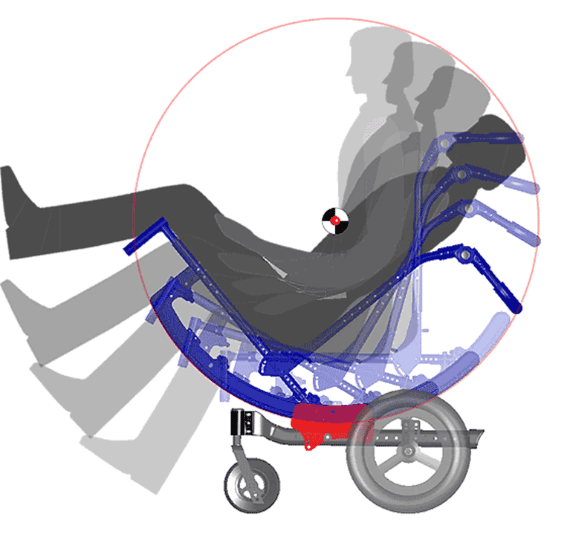
3. Rotational Tilt Mechanisms
The newest designs use a rotational pivot point that stays aligned with your centre of gravity. This means your weight doesn’t shift backward or forward as you tilt. It makes the tilt smoother and easier to use, and it keeps the wheelchair stable without needing a long wheelbase.
Because the centre of gravity stays in nearly the same place during tilt, the wheelchair is easier to push and turn — and caregivers find it easier to help the user tilt with less effort.
Why It Matters for You
The type of tilt mechanism affects:
-
Comfort & Pressure Relief: A smoother tilt helps redistribute body weight without sliding, making long sitting more comfortable.
-
Stability: Newer mechanisms help keep the wheelchair stable even at larger tilt angles.
-
Ease of Use: Tilt mechanisms that avoid shifting your centre of gravity make it easier for caregivers or users to adjust position.
-
Maneuverability: Wheelchairs with advanced mechanisms can be more compact and easier to steer.
In Short
Manual tilt-in-space wheelchairs come with different tilt technologies. Older pivot systems move your centre of gravity more, which can make the chair larger and harder to maneuver. Newer rotational systems keep your weight centered during tilt, helping make the chair more stable, easier to use, and more comfortable overall.
QUICKIE IRIS
QUICKIE's tilt-in-space wheelchairs help to facilitate feeding and respiratory function, reduce pressure beneath the pelvis, and improve visual alignment by holding the head upright.
Positioning Wheelchair
Rotation in Space
The ultimate tilt-in-space wheelchair. With 55° of Intelligent Rotation in Space Technology. Helps to facilitate feeding and respiratory function, reduce pressure beneath the pelvis, and improve visual alignment by holding the head upright.

8 Key Clinical Benefits of Tilt
Tilting in space isn’t just about comfort — it’s a clinically beneficial feature
-
Provides changes in position for clients who cannot weight shift independently.
-
Provides changes in position for clients who cannot maintain pelvic, thoracic, or head position and/or balance against gravity for prolonged periods of time.
-
Provides appropriate position for clients who are at risk for respiratory complications.
-
Provides appropriate position for clients who are at risk for digestive complications.
-
Provides appropriate position for clients who are at risk for postural hypotension.
-
Provides appropriate position for clients who are at risk for autonomic dysreflexia.
-
Provides a change in position while minimizing the risk of extensor spasticity.
-
Provides a change in position without the risk of shear forces.


Making Life Easier ...
At Home Mobility, we provide solutions to every day Mobility problems in and outside home.
Our goal is to improve the quality of life of our Customers. We make sure to give you a solution tailored to your specific needs.
Our products are designed to promote independent lifestyles; They are carefully selected from reputed brands & meet the highest safety standards.
... That's What We Do!